

The Savvy Diaries No. 3 — What's in a Name?
Questions I ponder in pursuit of the "Proven, Better, New HQ"

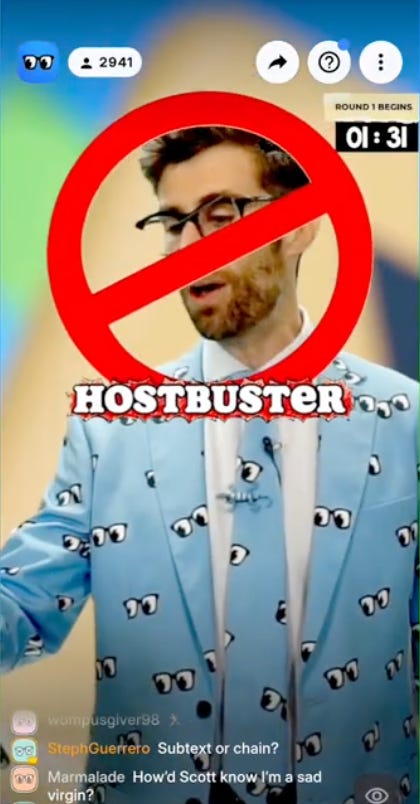
Should ‘Hostbuster’ be one word or two?
Should the winners of each round be called ‘Round Busters’ or ‘Round Pounders’?
Should we change the name of the power-up that highlights a yellow letter on the keyboard to ‘Clue Gun’ — and have it shoot yellow paint on the letter — or should we stick with ‘Magniflyer’ — a magnifying glass that flies over the letter, turning it yellow?
If we go with Clue Gun, then we could also introduce a ‘Cluezooka’ which sprays paint onto TWO letters…
These are the questions that have been keeping me up at night as Savvy steadfastly marches toward relaunch, planned for the end of Q3.
Perfectly asinine questions, you might be thinking. What difference could it possibly make to go with Hostbuster over Host Buster? Shouldn’t you be losing sleep over things like the ever-looming threats of WWIII, climate catastrophe, or a Spencer Pratt mayoralty?
But as Chief Creative Officer, co-founder, and co-funder of a bootstrapped startup into which I’m staking my life savings and professional reputation — and as a clinically diagnosed obsessive-compulsive — it’s both my job and neurochemical nature to elevate these seemingly minor considerations to DEFCON 1.
It’s been three months since we wrapped the pilot season of TextSavvy, producing 24 episodes from Forever Dog Studios, organically growing our nightly audience from 1,500 to over 6,000, reaching 12,800 monthly active users, and clocking eye-popping retention numbers (D1 61%, D7 40%, D30 33%, W4 46%). In startup speak, that’s called true signal.
Encouraged by the rapid early adoption and replete with user feedback and useful metrics, we decided to land the planestopped down regular production to direct the team’s full attention and energy to build mode, airing shows only when there was a new app update to test. And realizing our production ambitions had already exceeded our limited rental budget, we reevaluated our studio partnership model and pivoted to a DIY approach. I’m writing this diary entry from the future home of Savvyversal Studios: a live/work loft in the foothills of Universal Studios which I moved into TODAY! Can you tell I’m using freshly installed internet? The Spectrum guy just left!!!
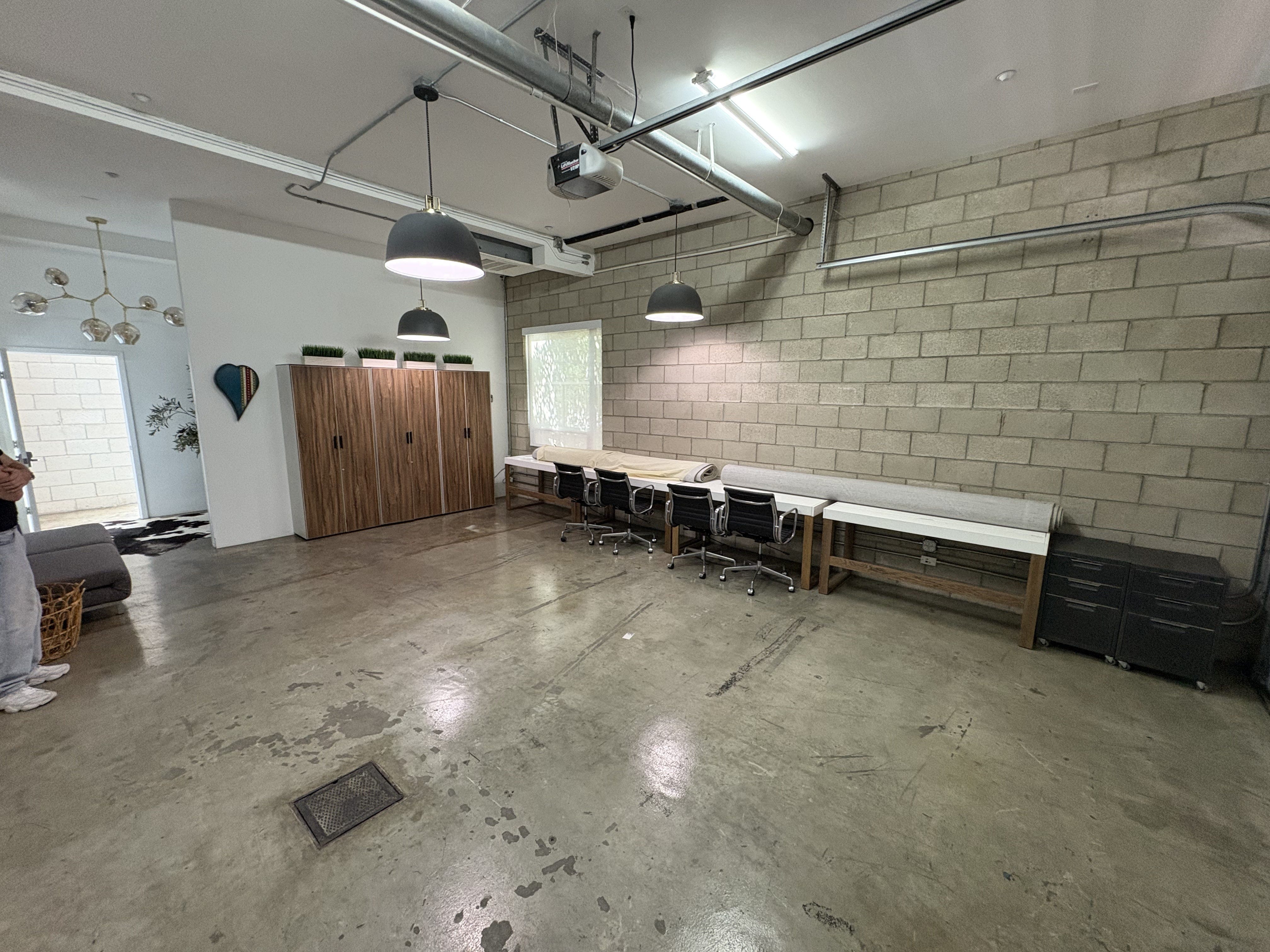
My co-founder Josh is joining me here at the end of the month, moving from Dallas, and we’re going full Wozniak/Jobs.1 I’m looking forward to the world’s shortest commute, and as strange as it might sound coming from a middle-aged man who hasn’t had a non-romantic roommate in nearly a decade, I’m also looking forward to our shared living scenario. We may be twenty years past due, but Josh and I are finally getting to live out the garage band fantasy every young dork dreams of! It’s Van Halen meets Hewlett-Packard meets Rupert Pupkin!
But I’m most excited about what we’re building with Savvy.
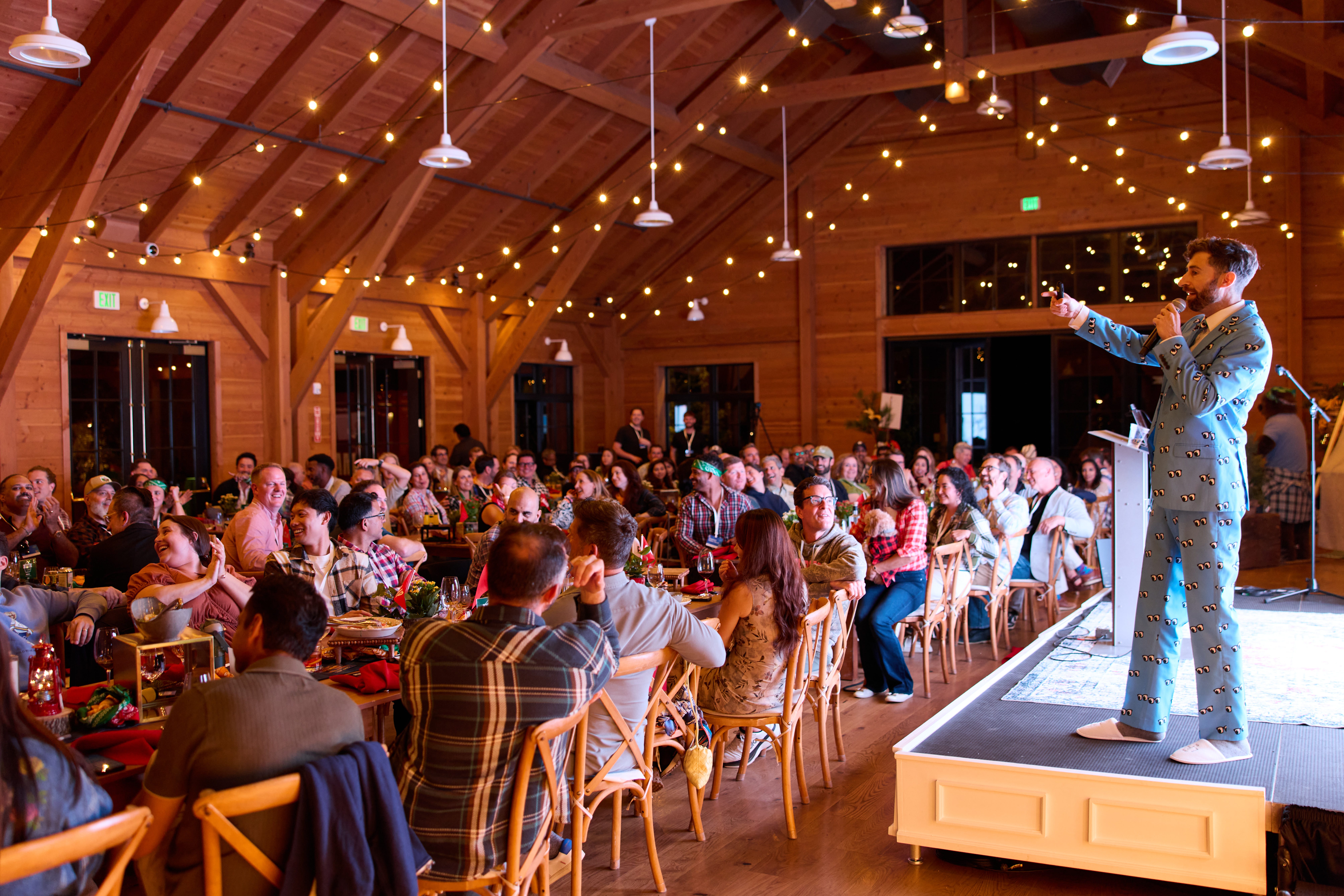
On the recommendation of new friend Rebecca Liebman — co-founder and CEO of LearnLux and one of many amazing people I met at the Finger Lakes Summit in Canandaigua, NY where I hosted Savvy’s first-ever “road show” as a special treat for attendees — I picked up Mark Pincus’s new book, Life at the Speed of Play. It’s a terrific read that curiously felt like it was written exactly for me at this exact moment in my life and career.2
In it Mark describes a framework called “Proven, Better, New,” which he used to guide the development of hit products at Zynga — the mobile gaming powerhouse behind familiar titles like FarmVille and Words with Friends that he founded in 2007.3
The philosophy advocates not for inventing from scratch, but rather for starting with an existing product that the market has already validated, copying its best attributes and meaningfully improving on its flaws, and adding a novel twist to fully distinguish it in the marketplace.
Without having a catchy name for it, that’s exactly the framework we have been using over these past 18 months in the development of Savvy, which I’m now confidently and succinctly pitching as the “Proven, Better, New HQ.”
HQ proved several things:
product-market fit — people want live, shared, competitive mobile experiences (see: 15 million downloads and 4 million peak concurrent viewers)4
distribution model — appointment-based viewing and FOMO-driven engagement via synchronous push notifications
monetization model — $15m in Y1 sponsorship revenue alone
But despite its viral success, HQ Trivia was a severely flawed product further hampered by well-documented leadership failures, which ultimately led to its untimely demise. Take the game play: a player had to answer twelve consecutive questions of drastically increasing difficulty in order to win. In a typical episode, 30–50% of players were eliminated by the fourth question, and 70–90% by the sixth. No ‘play-through’ mode to continue answering for funsies. No points or consolation rewards to show for your time and effort. Once you were bounced, that was it. So long, good luck.5
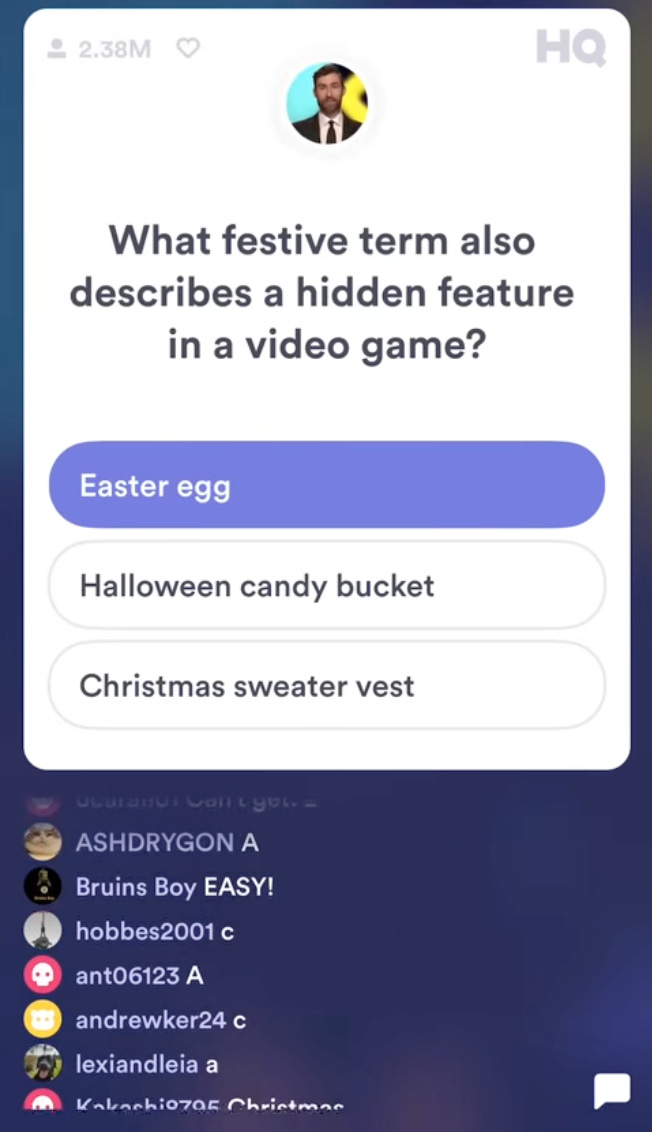
Did this mass elimination method maximize the sense of excitement for survivors, leading to moments like this one for the game’s rarefied winners? Sure. But that came at the expense of the majority’s enjoyment. Try to think of another product that stops serving 90% of its customers halfway through the experience. Imagine a Broadway show kicking out 90% of its patrons at intermission, or an omakase restaurant booting half its diners after the edamame. It’s no wonder HQ Trivia suffered from an industry-leading churn rate — never a category you want to lead — with the average user only playing 2-3 games before calling it quits.6
Savvy makes demonstrable improvements to HQ’s core game loop. Firstly, no elimination means everyone gets to play every game all the way through. What a concept!
Secondly, we’re incorporating retention mechanics basic to just about every casual mobile game but noticeably absent from HQ: points, streaks, stats, and an on-demand version of the game (Daily Puzzle) to keep users entertained between live shows.
After experimenting in our beta and pilot seasons with various methods of giving away cash prizes, we’re transitioning to a mostly cashless rewards system, introducing Sparks — our in-game currency which can be used to redeem exclusive digital and physical prizes that filthy lucre cannot buy.7 Sparks will be awarded to winners of each round, winners of the overall game, solvers of our Daily Puzzle, and gifted to users who invite friends to the app and share their game stats to social.
We’re also improving on the monetization model by launching with a Super Savvy membership plan, offering perks to paying users — including exclusive access to our remaining test shows.
What’s new with Savvy? Our novel interactivity layer that allows YOU to play against ME. I’m not just the compère like I was on HQ Trivia — on Savvy, I’m also the competition. All of our formats will be defined by this audience-versus-host dynamic. Imagine if on HQ, I didn’t simply ask the questions… I answered them with you. And the way to win was to get more right than me.
Should I spill ALL the beans on what else we’re cooking up? I think I’ll save some surprises for a future post. Besides, it’s another gorgeous day in LA and I haven’t yet stepped outside to greet that big blazing star in the sky.
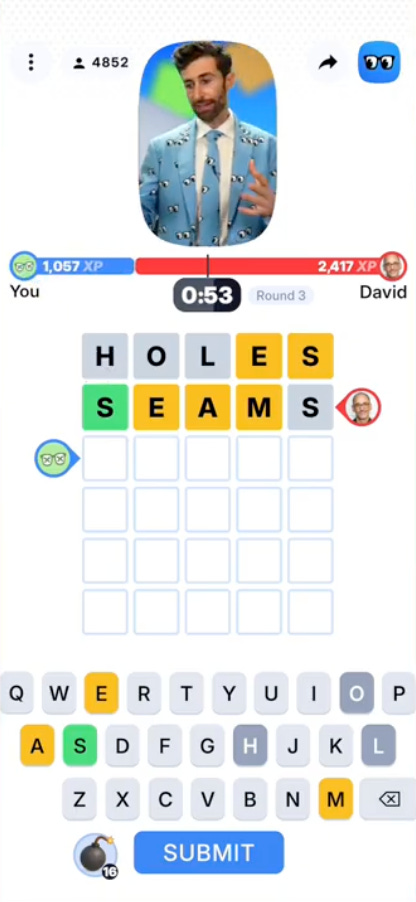
But I’ll wrap this up by returning to the title of this entry: What’s in a Name? Eagle-eyed readers might have caught the fact that I dropped Text from TextSavvy when referring to our flagship format. That’s because TextSavvy is DEAD AND BURIED, for reasons thrice:
For as clever a name as it is (thank you very much), TextSavvy is a little tough on the ol’ tongue. Gotta really enunciate that Text part. And enunciating is no fun.
When considering the category-specific spin-offs we plan to roll out in Q4 (SportSavvy, TuneSavvy, CineSavvy), I realized TextSavvy could technically describe all of them. I briefly flirted with a taxonomy that looked like TextSavvy: Sports, TextSavvy: Music, TextSavvy: Movies… but then I thought, “That’s dumb.”
We’re making so many changes to the show that it’s deserving of a new title.
Scotty Boy only lost a few weeks’ sleep over that decision, but there you have it. To the 25,000 people who played TextSavvy, we appreciate you. You’re invited to the shiva. And to the millions of you who have yet to step up to the plate for this first-of-its-kind entertainment experience, all I can say is download the app now, start sharpening your skills with the Daily Puzzle, and hold onto your butts for Season 1 of Savvy. COMING SOON.
Among the many eerie synchronicities between Mark and myself: saying the thing we’re sure will gets us hired — which in actuality gets us fired, founding a mobile gaming company at 41 after coming out of a lengthy “abyss,” and manifesting a meeting with Alicia Silverstone in 2018.
Pincus was Zynga’s on-and-off-again CEO and was serving as its non-executive Chairman of the Board when it was acquired in 2022 by Take-Two Interactive (publishers of Grand Theft Auto) in a cash-and-stock deal valued at $12.7 billion.
The oft-cited number is ~2.4 million — which is the number of live connected devices that were tuned to the March 28, 2018 episode promoting Ready Player One, the first of a three-show, $3 million sponsorship deal with Warner Bros. But after hiring the Nielsen Company to analyze our audience size, they concluded our concurrent viewer count deserved a 1.7x multiplier to arrive at a more accurate accounting of our total viewers — think about friends and family crowding around a connected device, but not connected themselves — translating that 2.4 million CCV figure to 4 million viewers.
Among those quick to churn: Stephen Colbert, who admitted to me off-camera when I appeared as a guest on the Late Show that he played “a couple times, didn’t win,” and stopped playing.
We’re retaining the ability to give away money and plan to do so on special occasions — especially if a sponsor is footing the bill. Email hello@playsavvy.live to be the hero sponsor our Savvants deserve!